
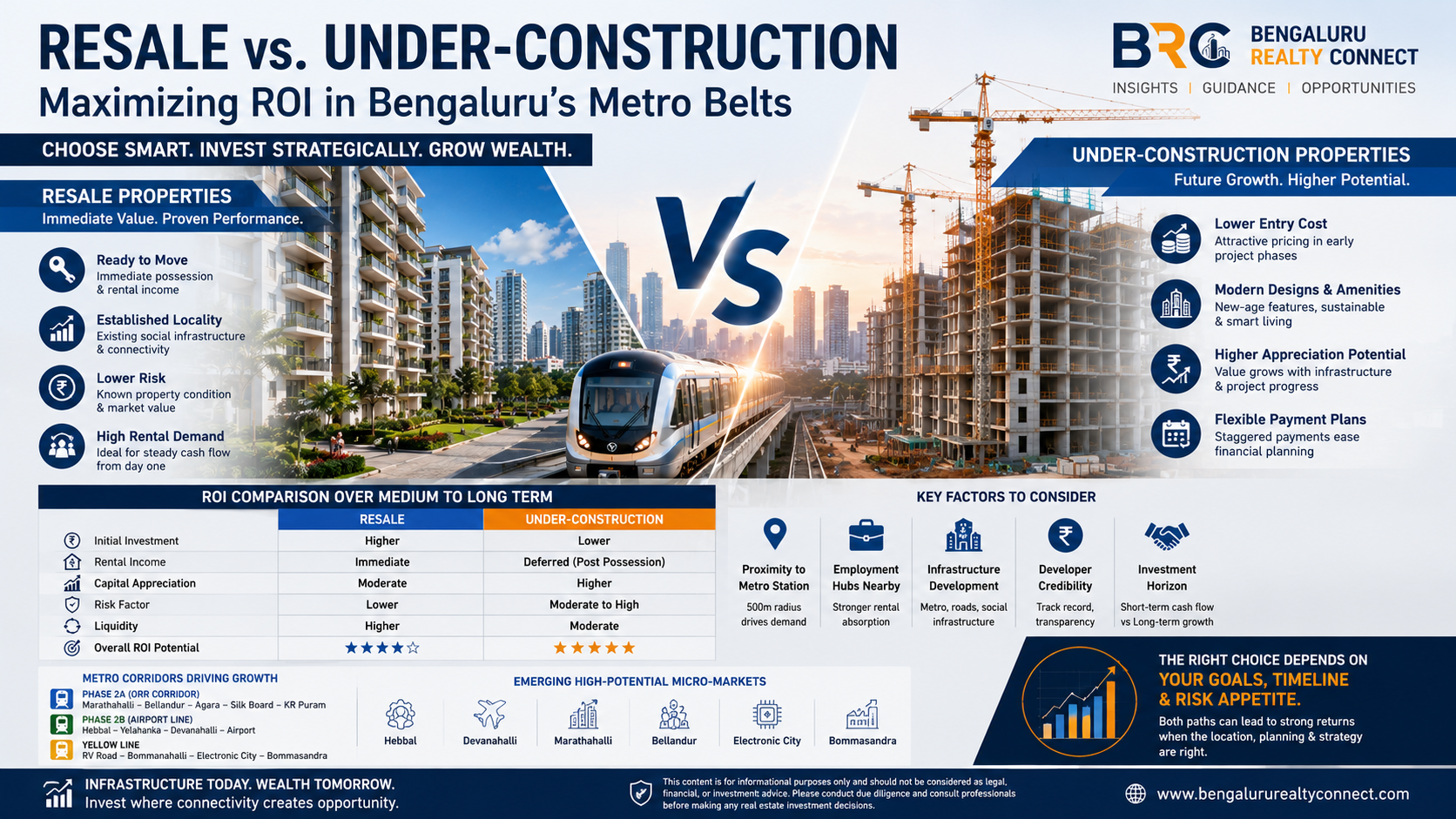
The Metro Effect Is Changing Investment Decisions
Bengaluru's real estate landscape is undergoing a remarkable transformation, driven by one of India's largest urban infrastructure projects—the expansion of Namma Metro. With Metro Phase 2A, Phase 2B, the Yellow Line, Blue Line, and future extensions, neighborhoods once considered peripheral are becoming well-connected urban centres. As metro connectivity reshapes demand, investors are increasingly faced with a critical question:
Should you buy a resale property near an operational metro station or invest in an under-construction project along an upcoming metro corridor?
The answer depends on your investment objectives, risk appetite, holding period, and cash flow expectations. Both asset classes present unique advantages, and understanding the trade-offs is essential for maximizing long-term returns.
Understanding the Metro Premium
Metro infrastructure does more than improve mobility. It transforms neighborhoods by reducing travel time, increasing employment accessibility, enhancing social infrastructure, and attracting commercial development. Historically, metro connectivity has influenced both rental demand and capital appreciation in major Indian cities.
In Bengaluru, metro-connected locations are witnessing growing demand from IT professionals, GCC employees, startup founders, healthcare workers, students, and business executives who value convenience and predictable commuting.
However, the timing of investment significantly influences returns.
Resale Properties: Immediate Utility and Rental Income
Resale properties are homes that are already completed and often occupied. Investors can physically inspect the property, understand the neighborhood, evaluate actual construction quality, and begin earning rental income immediately after purchase.
This makes resale properties particularly attractive in mature metro corridors where connectivity already exists.
Advantages
✅ Immediate possession
✅ Immediate rental income
✅ Existing social infrastructure
✅ Established market pricing
✅ Lower construction uncertainty
✅ Easier property inspection
Completed metro corridors often experience strong tenant demand due to their proximity to employment centres.
Challenges with Resale Properties
Resale homes may command higher acquisition prices because metro connectivity is already operational. Older projects may also involve higher maintenance costs, renovation requirements, or outdated amenities compared to newer developments.
Under-Construction Projects: Investing in Future Growth
Under-construction properties are often purchased before or during project development. These investments are particularly popular in emerging metro corridors where infrastructure is still under construction.
Developers frequently launch projects at relatively competitive prices during early phases, offering investors the possibility of benefiting from future infrastructure-led appreciation if the project is completed as planned and market conditions remain supportive.
Advantages
✅ Lower entry price (project-specific)
✅ New-age amenities
✅ Smart home technologies
✅ Better payment flexibility
✅ Potential appreciation during construction
✅ Modern sustainable designs
Many buyers also prefer under-construction projects because they offer contemporary layouts, larger community amenities, and green building features.
Challenges with Under-Construction Investments
Investments in under-construction projects involve uncertainties, including construction delays, changes in market conditions, infrastructure timelines, financing costs, and project execution risks. Investors should carefully evaluate the developer's track record, legal approvals, RERA registration, financial stability, and project documentation.
Metro Corridors Creating Investment Opportunities
Phase 2A (Outer Ring Road)
High rental demand driven by technology companies.
Investment focus:
- Bellandur
- Marathahalli
- Kadubeesanahalli
- Agara
- Silk Board
Phase 2B (Airport Corridor)
Strong long-term appreciation potential supported by Airport City, Aerospace Corridor, and GCC expansion.
Investment focus:
- Hebbal
- Yelahanka
- Jakkur
- Bagaluru
- Devanahalli
Yellow Line
Excellent rental demand from IT and manufacturing professionals.
Investment focus:
- Electronic City
- Bommasandra
- Bommanahalli
ROI Comparison
| Parameter | Resale Property | Under Construction |
|---|---|---|
| Immediate Rental Income | ⭐⭐⭐⭐⭐ | ⭐⭐☆☆☆ |
| Capital Appreciation Potential | ⭐⭐⭐⭐☆ | ⭐⭐⭐⭐⭐ |
| Construction Risk | ⭐⭐⭐⭐⭐ | ⭐⭐⭐☆☆ |
| Entry Pricing | ⭐⭐⭐☆☆ | ⭐⭐⭐⭐☆ |
| Modern Amenities | ⭐⭐⭐☆☆ | ⭐⭐⭐⭐⭐ |
| Immediate Occupancy | ⭐⭐⭐⭐⭐ | ⭐☆☆☆☆ |
| Long-Term Growth | ⭐⭐⭐⭐☆ | ⭐⭐⭐⭐⭐ |
Who Should Buy Resale Properties?
Resale properties may be suitable for investors seeking:
- Immediate rental income
- Lower execution risk
- Completed infrastructure
- Ready possession
- Established communities
Who Should Buy Under-Construction Properties?
Under-construction projects may appeal to buyers who:
- Have a longer investment horizon
- Seek modern amenities
- Can accommodate construction timelines
- Aim for potential infrastructure-led appreciation
- Prefer phased payment structures
BRC Investment Perspective
"The question is not whether resale or under-construction properties are inherently better. The better investment is the one that aligns with your financial goals, investment horizon, and the long-term economic fundamentals of the location. In Bengaluru's metro belts, employment growth, infrastructure, connectivity, and quality of development matter far more than simply choosing between a new or existing property."
Emerging High-Potential Metro Micro-Markets
📍 Hebbal
📍 Devanahalli
📍 Yelahanka
📍 Electronic City
📍 Bellandur
📍 Marathahalli
📍 Bommasandra
📍 Whitefield
📍 KR Puram
📍 Sarjapur Road (via interchange connectivity)
Due Diligence Checklist
Before investing, evaluate:
✔ Metro station proximity
✔ Developer reputation
✔ RERA registration
✔ Legal documentation
✔ Infrastructure progress
✔ Rental demand
✔ Employment ecosystem
✔ Social infrastructure
✔ Maintenance costs
✔ Exit potential
Future Outlook
As Bengaluru's metro network expands beyond 175 km in the coming years, investment opportunities will increasingly shift from isolated projects to integrated transit-oriented communities. Properties located near employment centres, mixed-use developments, educational institutions, healthcare facilities, and metro stations are likely to remain attractive for both end-users and investors.
Rather than chasing speculative gains, investors should focus on neighbourhood quality, connectivity, long-term demand drivers, and legal compliance.
BRC Investment Scorecard
| Investment Criteria | Resale | Under Construction |
|---|---|---|
| Rental Income | ⭐⭐⭐⭐⭐ | ⭐⭐☆☆☆ |
| Appreciation Potential | ⭐⭐⭐⭐☆ | ⭐⭐⭐⭐⭐ |
| Investment Risk | ⭐⭐⭐⭐☆ | ⭐⭐⭐☆☆ |
| Liquidity | ⭐⭐⭐⭐☆ | ⭐⭐⭐⭐☆ |
| Modern Features | ⭐⭐⭐☆☆ | ⭐⭐⭐⭐⭐ |
Related BRC Articles
- Metro Phase 2A, 2B & Yellow Line: Micro-Markets Seeing the Highest Rental Yields
- Namma Metro and Property Appreciation
- Airport City Bengaluru
- North Bengaluru Investment Guide
- Commercial Fractional Ownership
- Luxury Housing Market Report
- Global Capability Centres and Real Estate
Disclaimer
This article is intended solely for educational and informational purposes and should not be interpreted as legal, financial, tax, or investment advice. Property values, rental yields, construction timelines, financing costs, and infrastructure projects are subject to change. Under-construction projects involve execution and market risks, while resale properties may have maintenance, pricing, or legal considerations. Readers should independently verify project approvals, legal documentation, RERA registration, and market conditions, and consult qualified legal, financial, and real estate professionals before making any investment decision.

Leave a comment
Your email address will not be published. Required fields are marked *

