
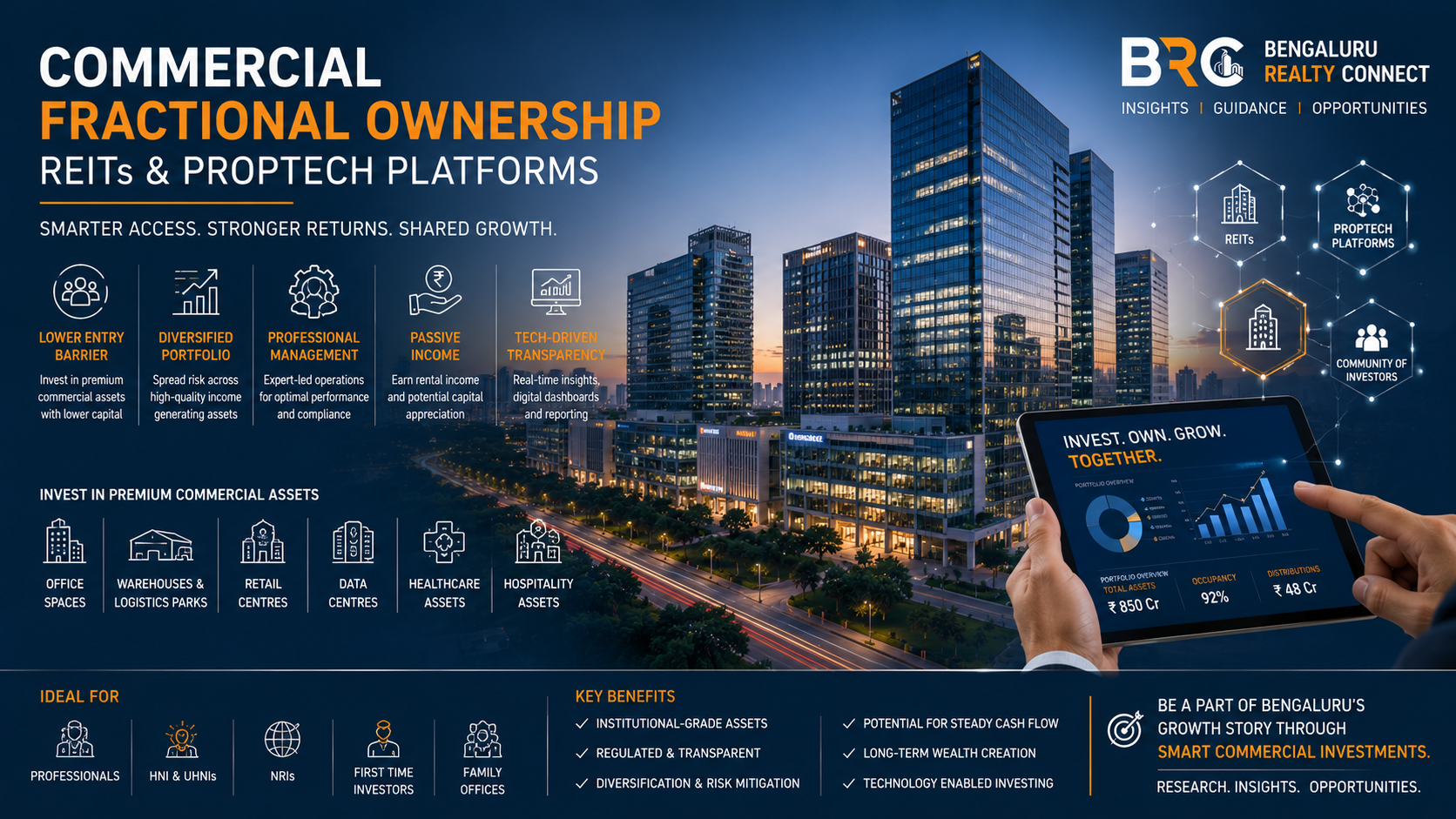
Commercial Fractional Ownership: Redefining Real Estate Investing for the Modern Investor
Commercial real estate has traditionally been viewed as an asset class reserved for institutional investors, ultra-high-net-worth individuals (UHNIs), and large corporations. Owning premium office buildings, technology parks, warehouses, or retail assets often required substantial capital and specialized expertise. However, this landscape is changing rapidly with the rise of Commercial Fractional Ownership, Real Estate Investment Trusts (REITs), and PropTech investment platforms that are making high-quality commercial assets accessible to a much wider pool of investors.
Rather than purchasing an entire commercial property, fractional ownership allows multiple investors to collectively own a professionally managed asset. Each investor holds a proportionate ownership interest or investment exposure, enabling participation in institutional-grade real estate with significantly lower capital than would otherwise be required. Similarly, publicly listed REITs provide exposure to income-generating real estate portfolios through stock exchanges, while PropTech platforms are using technology to streamline investment, management, reporting, and transparency.
For Bengaluru—a city widely recognised as India's technology capital and home to one of the country's largest concentrations of Global Capability Centres (GCCs), multinational corporations, and startup ecosystems—commercial fractional ownership is gaining increasing attention. The city's robust office market, expanding warehousing sector, data centres, life sciences parks, and retail developments provide a strong foundation for professionally managed commercial investments.
Why Fractional Ownership is Growing
Several structural trends are driving the popularity of fractional commercial real estate investments.
The first is affordability. Premium commercial properties typically require significant capital outlays, making direct ownership inaccessible for many investors. Fractional ownership lowers this barrier by allowing investors to participate with comparatively smaller investment amounts, depending on the platform and asset.
The second driver is professional management. Commercial buildings require tenant management, leasing, facility maintenance, legal compliance, and operational oversight. Fractional ownership structures and REITs are generally managed by experienced professionals, allowing investors to benefit from institutional expertise without handling day-to-day operations.
Technology has further accelerated adoption. Modern PropTech platforms offer digital onboarding, transparent documentation, online dashboards, performance reporting, distribution tracking, and streamlined communication, making commercial real estate investing significantly more accessible and efficient.
Understanding the Different Investment Models
Real Estate Investment Trusts (REITs)
REITs are regulated investment vehicles that own and operate income-generating real estate. Investors purchase units listed on stock exchanges and may benefit from rental income distributions and changes in unit prices. REITs typically hold diversified portfolios across office buildings, retail assets, warehouses, or other commercial properties, helping reduce concentration risk.
Commercial Fractional Ownership
Fractional ownership involves investing in a specific commercial asset alongside other investors. These assets may include Grade A office buildings, technology parks, logistics facilities, warehouses, healthcare assets, hospitality projects, or retail developments. Returns generally depend on factors such as rental performance, occupancy, operating costs, financing structure (where applicable), and the eventual exit value of the asset.
PropTech Investment Platforms
PropTech companies use digital technology to simplify commercial real estate investing. Their role may include property sourcing, due diligence, investor onboarding, documentation, asset management, reporting, and facilitating investment opportunities. Platform structures, investor rights, governance, liquidity, and fees vary, so investors should carefully review all documentation before investing.
Why Bengaluru is a Strong Market
Bengaluru remains one of India's most resilient commercial real estate markets due to its diversified economy and sustained demand from technology, engineering, biotechnology, aerospace, fintech, artificial intelligence, and research industries.
Key demand drivers include:
- Global Capability Centres (GCCs)
- Information Technology companies
- Startup ecosystem
- Engineering and R&D centres
- Aerospace & Defence industries
- Life sciences and biotech
- Warehousing and logistics
- Data centre expansion
These sectors continue to support demand for high-quality office spaces, industrial facilities, logistics parks, and mixed-use commercial developments.
Commercial Asset Classes Seeing Investor Interest
🏢 Grade A Office Buildings
📦 Warehousing & Logistics Parks
🛍 Premium Retail Centres
🏥 Healthcare Real Estate
🔬 Life Sciences & Research Parks
💻 Data Centres
🏨 Hospitality Assets
🏭 Industrial Parks
Advantages of Commercial Fractional Ownership
Lower Capital Requirement
Enables participation in commercial real estate without purchasing an entire property.
Institutional-Quality Assets
Access to professionally developed Grade A commercial buildings.
Professional Asset Management
Specialized teams oversee leasing, maintenance, compliance, and operations.
Portfolio Diversification
Can complement residential real estate, equities, fixed income, and other investments.
Technology-Driven Transparency
Digital reporting, documentation, and investor dashboards improve accessibility.
Important Considerations Before Investing
Commercial fractional ownership should not be viewed as a guaranteed-return product. Investors should evaluate:
✔ Legal ownership structure
✔ Asset quality
✔ Tenant profile
✔ Lease tenure
✔ Occupancy history
✔ Asset location
✔ Platform governance
✔ Fee structure
✔ Liquidity provisions
✔ Exit mechanisms
✔ Regulatory compliance
✔ Risk disclosures
Professional financial and legal advice should be obtained before making investment decisions.
Bengaluru Micro-Markets Supporting Commercial Growth
📍 Whitefield
📍 Outer Ring Road (ORR)
📍 Hebbal
📍 Electronic City
📍 North Bengaluru
📍 Devanahalli
📍 Bellandur
📍 Sarjapur Road
📍 Manyata Tech Park Corridor
📍 Airport City Bengaluru
Future of Fractional Commercial Investing
Artificial Intelligence, blockchain-enabled documentation, smart contracts, tokenisation (subject to applicable regulations), digital property management, ESG reporting, predictive analytics, and data-driven asset management are expected to continue shaping the evolution of commercial real estate investment.
While these innovations improve transparency and efficiency, investors should distinguish between established regulated investment products and emerging technologies that may still be evolving.
BRC Investment Perspective
"Commercial fractional ownership is changing how investors access premium real estate. Rather than replacing traditional property ownership, it offers an additional avenue for portfolio diversification and participation in institutional-grade commercial assets. Success depends on careful due diligence, understanding the investment structure, and selecting quality assets supported by strong economic fundamentals."
BRC Investment Scorecard
| Parameter | Rating |
|---|---|
| Accessibility | ⭐⭐⭐⭐⭐ |
| Professional Management | ⭐⭐⭐⭐⭐ |
| Diversification Potential | ⭐⭐⭐⭐⭐ |
| Commercial Demand | ⭐⭐⭐⭐⭐ |
| Technology Integration | ⭐⭐⭐⭐⭐ |
| Due Diligence Importance | ⭐⭐⭐⭐⭐ |
Overall BRC Commercial Fractional Ownership Score: 9.5/10
Related BRC Articles
- Global Capability Centres (GCCs) and Commercial Real Estate
- Luxury Housing Market Report
- Aerospace & Defence Corridor: Investment Opportunities
- Metro Phase 2A, 2B & Yellow Line: High Rental Yield Corridors
- North Bengaluru: India's Biggest Investment Opportunity
- Warehousing & Logistics: The Future of Industrial Real Estate
Useful Resources
- Securities and Exchange Board of India (SEBI):
- National Stock Exchange (NSE):
- Bombay Stock Exchange (BSE):
- Karnataka RERA:
Disclaimer
This article is intended solely for educational and informational purposes and should not be interpreted as investment, legal, tax, or financial advice. Commercial fractional ownership, REITs, and PropTech platforms differ in structure, regulation, fees, liquidity, governance, and risk profile. Investment performance depends on market conditions, occupancy, tenant quality, property management, and regulatory developments. Readers should independently review offering documents, legal structures, regulatory disclosures, and consult qualified financial, legal, and tax professionals before investing. Bengaluru Realty Connect (BRC) and Finfairs Global Private Limited do not endorse or recommend any specific REIT, platform, or investment product.

Leave a comment
Your email address will not be published. Required fields are marked *

