
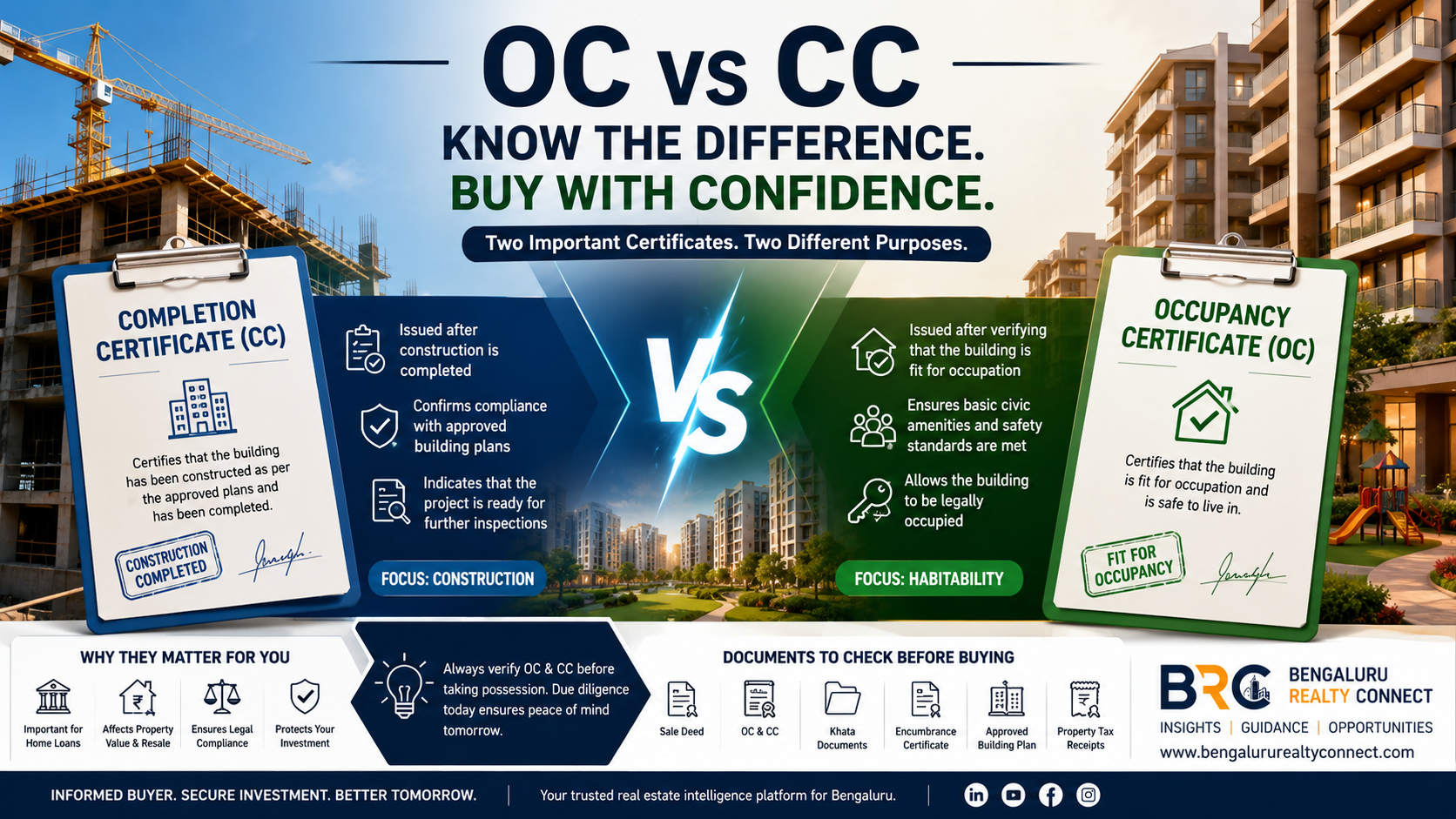
OC vs CC: Two Property Documents Every Homebuyer Should Verify Before Taking Possession
Buying a home is one of the most significant financial decisions in a person's life. Yet many buyers focus only on location, builder reputation, and price while overlooking two critical documents that determine whether a building has been completed in accordance with approved plans and whether it is ready to be legally occupied—the Completion Certificate (CC) and the Occupancy Certificate (OC). Although these documents are often confused, they serve different purposes, and understanding the distinction is essential for making an informed property investment in Karnataka.
What is a Completion Certificate (CC)?
A Completion Certificate (CC) is issued by the competent local authority after verifying that a building has been constructed substantially in accordance with the sanctioned building plans, applicable regulations, and approved specifications.
The Completion Certificate generally confirms that:
- Construction has been completed.
- The building substantially conforms to approved plans.
- Applicable building regulations have been complied with, subject to the authority's verification.
- The project is ready for inspection for occupancy, where required.
A Completion Certificate does not automatically authorize occupation of the building.
What is an Occupancy Certificate (OC)?
An Occupancy Certificate (OC) is issued by the competent authority after verifying that the completed building is fit for occupation and meets the applicable requirements for occupancy.
An Occupancy Certificate generally indicates that:
- The building is considered fit for occupation by the authority.
- Essential civic services and infrastructure have been provided as required.
- Occupancy is permitted in accordance with applicable regulations.
For many apartment projects, taking possession after the required Occupancy Certificate has been issued offers greater confidence regarding statutory compliance.
OC vs CC: What's the Difference?
OC vs CC Comparison
Comparison of the primary purpose of Completion Certificate and Occupancy Certificate.
Completion Certificate (CC)Occupancy Certificate (OC)
| Completion Certificate (CC) | Occupancy Certificate (OC) |
|---|---|
| Confirms construction is completed substantially as approved | Confirms the building is fit for occupation |
| Issued after construction completion | Issued after required occupancy verification |
| Indicates construction compliance | Permits occupation where applicable |
| Usually precedes the OC | Normally issued after the CC and required inspections |
Why Are OC and CC Important?
These certificates are significant because they can influence:
Home Loan Processing
Many financial institutions consider statutory approvals and project documentation as part of their lending assessment.
Property Resale
Well-documented properties generally attract greater buyer confidence and may support smoother resale transactions.
Utility Connections
Depending on the project and local regulations, certain civic services may be linked to statutory approvals.
Legal Due Diligence
Verifying project documentation helps reduce the risk of future disputes and supports informed purchasing decisions.
Should You Buy a Property Without an OC?
This is one of the most common questions asked by homebuyers.
The answer depends on the specific facts of the project, applicable laws, and the advice of qualified legal professionals.
Before purchasing a property, buyers should:
- Verify whether the required approvals have been issued.
- Understand the current regulatory status of the project.
- Review the Sale Agreement carefully.
- Seek independent legal advice.
- Verify all documents with the competent authority where necessary.
Documents Every Apartment Buyer Should Verify
Before taking possession, verify:
✅ Sale Deed
✅ Occupancy Certificate (OC), where applicable
✅ Completion Certificate (CC), where applicable
✅ Approved Building Plan
✅ Khata Certificate & Extract
✅ Encumbrance Certificate (EC)
✅ Property Tax Records
✅ RERA Registration (for applicable projects)
✅ Builder Approvals
✅ Maintenance & Association Documents
Common Myths
Myth 1
CC and OC are the same document.
Reality: They serve different purposes and are generally issued at different stages.
Myth 2
A famous builder guarantees all documentation is complete.
Reality: Buyers should independently verify all approvals regardless of the developer's reputation.
Myth 3
Only the Sale Deed matters.
Reality: The Sale Deed is important, but statutory approvals and supporting documents are also critical for comprehensive due diligence.
BRC Investment Perspective
At Bengaluru Realty Connect (BRC), we believe documentation is one of the strongest foundations of a secure property investment. Whether purchasing a home for self-occupation or investment, buyers should look beyond brochures and marketing promises. A comprehensive review of statutory approvals—including the Occupancy Certificate and Completion Certificate, where applicable—along with legal due diligence can help reduce risk and improve long-term confidence.
BRC Property Verification Checklist
Before purchasing any apartment or commercial property:
✔ Occupancy Certificate (OC)
✔ Completion Certificate (CC)
✔ Sale Deed
✔ Encumbrance Certificate (EC)
✔ Khata Documents
✔ RERA Registration
✔ Approved Building Plans
✔ Property Tax Records
✔ Identity of the Seller
✔ Legal Verification by an Advocate
Related BRC Articles
- A Khata vs B Khata vs E-Khata Explained
- Encumbrance Certificate (EC) Explained
- BBMP vs BDA vs BMRDA vs Gram Panchayat Properties
- Property Registration Process in Karnataka
- RERA Karnataka Explained
- Property Document Checklist Before Buying
Useful Official Resources
Disclaimer
This article is intended solely for educational and informational purposes and should not be construed as legal, financial, tax, or investment advice. The issuance, applicability, and legal effect of Occupancy Certificates (OC) and Completion Certificates (CC) may vary depending on the type of project, local authority, and prevailing regulations. Readers should independently verify all statutory approvals, project documentation, and legal compliances with the relevant authorities and consult qualified legal professionals before purchasing or investing in any property. Bengaluru Realty Connect (BRC) and Finfairs Global Private Limited shall not be responsible for decisions made based on this article.
#OccupancyCertificate #CompletionCertificate #OCvsCC #PropertyDocuments #KarnatakaRealEstate #HomeBuying #ApartmentBuying #RealEstateGuide #PropertyInvestment #RERAKarnataka #BengaluruRealEstate #BengaluruRealtyConnect #BRC #LegalAwareness #PropertyVerification

एक टिप्पणी छोड़ें
आपका ईमेल पता प्रकाशित नहीं किया जाएगा। आवश्यक फ़ील्ड * से चिह्नित हैं

