
Encumbrance Certificate (EC): The First Document Every Property Buyer Should Verify
Buying a property is one of the biggest financial decisions most people will make. Whether you are purchasing a plot, apartment, villa, commercial property, or industrial land, one document should always be verified before making any commitment—the Encumbrance Certificate (EC). Often overlooked by first-time buyers, the EC plays a critical role in establishing whether a property has a clear ownership history and whether it is free from registered financial or legal liabilities.
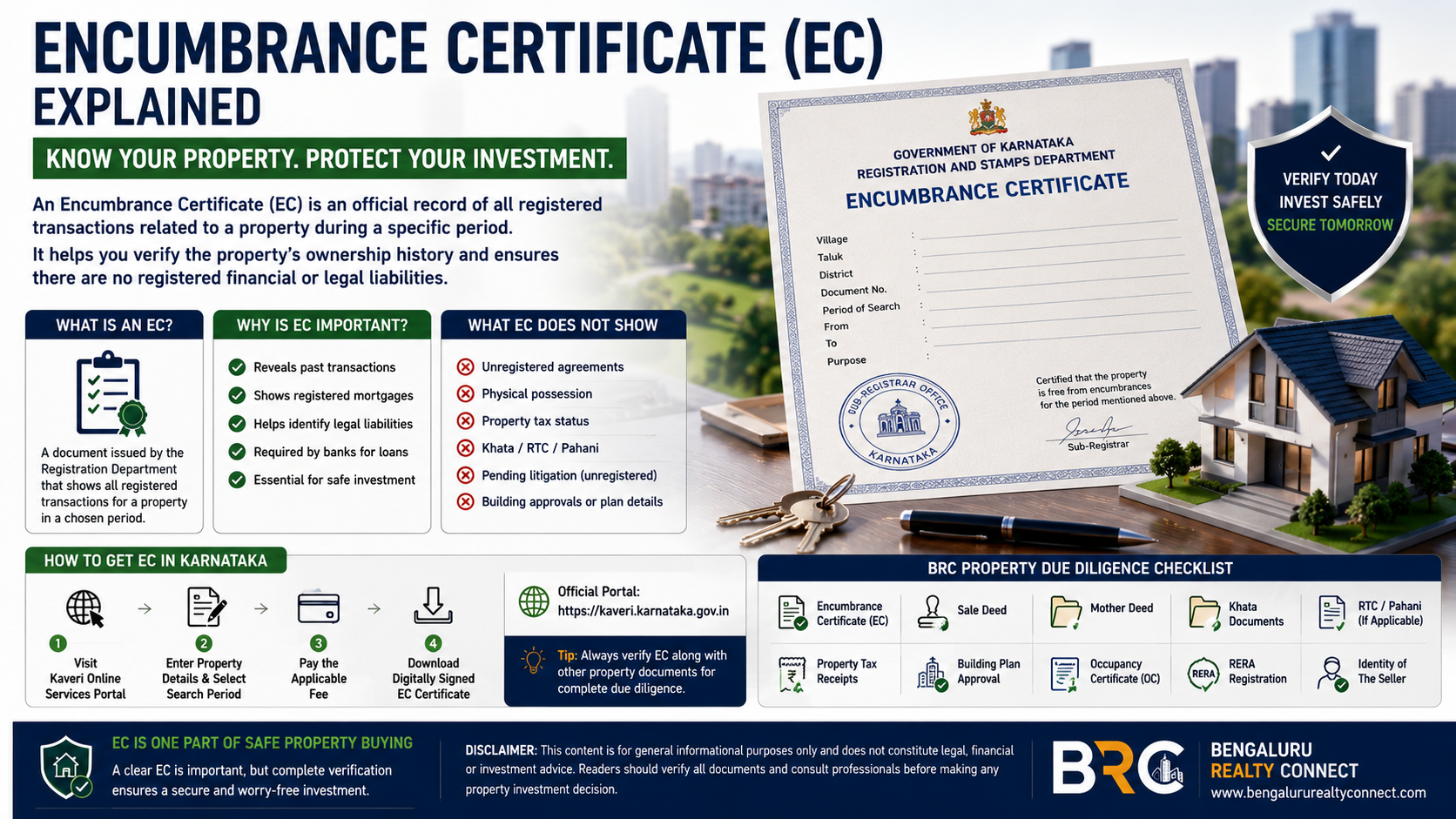
An Encumbrance Certificate is an official document issued by the Registration Department of Karnataka that records registered transactions relating to a property during a specified period. It provides details of registered sale deeds, gift deeds, mortgages, releases, partitions, and other transactions recorded with the Sub-Registrar's Office. If a property has no registered encumbrances during the requested period, a Nil Encumbrance Certificate may be issued.
Why is an EC Important?
An EC helps buyers verify whether a property has been involved in registered financial or ownership transactions. It is commonly used by banks, financial institutions, legal professionals, and buyers during property due diligence.
An EC can help verify:
- Registered ownership transactions
- Registered mortgages
- Registered sale deeds
- Gift deeds
- Partition deeds
- Release deeds
- Court attachments (where registered)
- Property transaction history
It is also one of the documents that lenders often request while processing home loans.
What an EC Does NOT Show
Many buyers assume an EC contains every legal detail about a property. That is not correct.
An EC generally does not include:
- Physical possession details
- Property tax payment status
- Revenue records (RTC/Pahani)
- Building plan approvals
- Khata status
- Unregistered agreements
- Pending litigation that has not been registered
- Land-use classification
- Government acquisition proposals
This is why relying solely on an EC is not sufficient. It should form part of a broader legal due diligence process.
How to Obtain an Encumbrance Certificate in Karnataka
In Karnataka, property owners and buyers can apply for an EC through the Kaveri Online Services Portal, managed by the Department of Stamps and Registration.
Official Portal:
https://kaveri.karnataka.gov.in
The process generally involves:
- Logging into the Kaveri Online Services portal.
- Entering the property details.
- Selecting the period for which the EC is required.
- Paying the applicable fee.
- Downloading the digitally generated certificate (where available).
When Should You Check an EC?
An EC should ideally be verified:
- Before purchasing any property.
- Before applying for a home loan.
- Before selling a property.
- Before entering into a Joint Development Agreement (JDA).
- During legal due diligence.
- Before investing in plots or agricultural land.
EC is Only One Part of Property Verification
A common mistake among buyers is believing that a clear EC automatically means the property is legally safe. In reality, a comprehensive property verification should also include:
✔ Sale Deed
✔ Mother Deed
✔ Khata Certificate & Extract
✔ RTC / Pahani (where applicable)
✔ Mutation Records
✔ Approved Layout Plan
✔ Building Plan Approval
✔ Occupancy Certificate (OC)
✔ Completion Certificate (CC)
✔ Property Tax Receipts
✔ Identity of the Seller
✔ RERA Registration (if applicable)
Professional legal verification remains one of the most important steps before completing any transaction.
Common Misconceptions About EC
Myth: A Nil EC means the property has no legal issues.
Reality: A Nil EC only indicates that no registered encumbrances were found during the selected period. It does not guarantee that the property is free from every legal issue.
Myth: EC proves ownership.
Reality: Ownership is established through title documents such as the Sale Deed and supporting records—not by the EC alone.
BRC Investment Perspective
At Bengaluru Realty Connect (BRC), we believe that informed investors are successful investors. An Encumbrance Certificate is one of the most important documents in property due diligence, but it should never be viewed in isolation. A combination of legal verification, document scrutiny, regulatory approvals, and professional advice helps reduce risk and supports confident investment decisions.
BRC Due Diligence Checklist
Before buying any property, verify:
✅ Encumbrance Certificate (EC)
✅ Sale Deed
✅ Mother Deed
✅ Khata Documents
✅ RTC/Pahani (if applicable)
✅ Layout Approval
✅ Building Approval
✅ Property Tax Records
✅ RERA Registration (where applicable)
✅ Identity of the Seller
Related BRC Articles
Useful Official Resources
- Kaveri Online Services
- Department of Stamps & Registration, Karnataka:
- Karnataka RERA
- Government of Karnataka:
Disclaimer
This article is intended solely for educational and informational purposes and should not be considered legal, financial, tax, or investment advice. An Encumbrance Certificate is only one of several documents required for comprehensive property due diligence. Buyers should independently verify all property documents, approvals, ownership records, land-use permissions, and statutory compliances with the relevant authorities. Laws, regulations, and procedures may change over time. Bengaluru Realty Connect (BRC) recommends consulting qualified advocates, legal professionals, and financial advisors before purchasing or investing in any property. Bengaluru Realty Connect (BRC) and Finfairs Global Private Limited shall not be liable for any decisions made based on the information contained in this article.
#EncumbranceCertificate #EC #PropertyDocuments #KarnatakaRealEstate #PropertyVerification #HomeBuying #PropertyInvestment #RealEstateGuide #LegalAwareness #KaveriOnline #BengaluruRealEstate #BengaluruRealtyConnect #BRC #InvestmentInsights #PropertyBuying

एक टिप्पणी छोड़ें
आपका ईमेल पता प्रकाशित नहीं किया जाएगा। आवश्यक फ़ील्ड * से चिह्नित हैं

